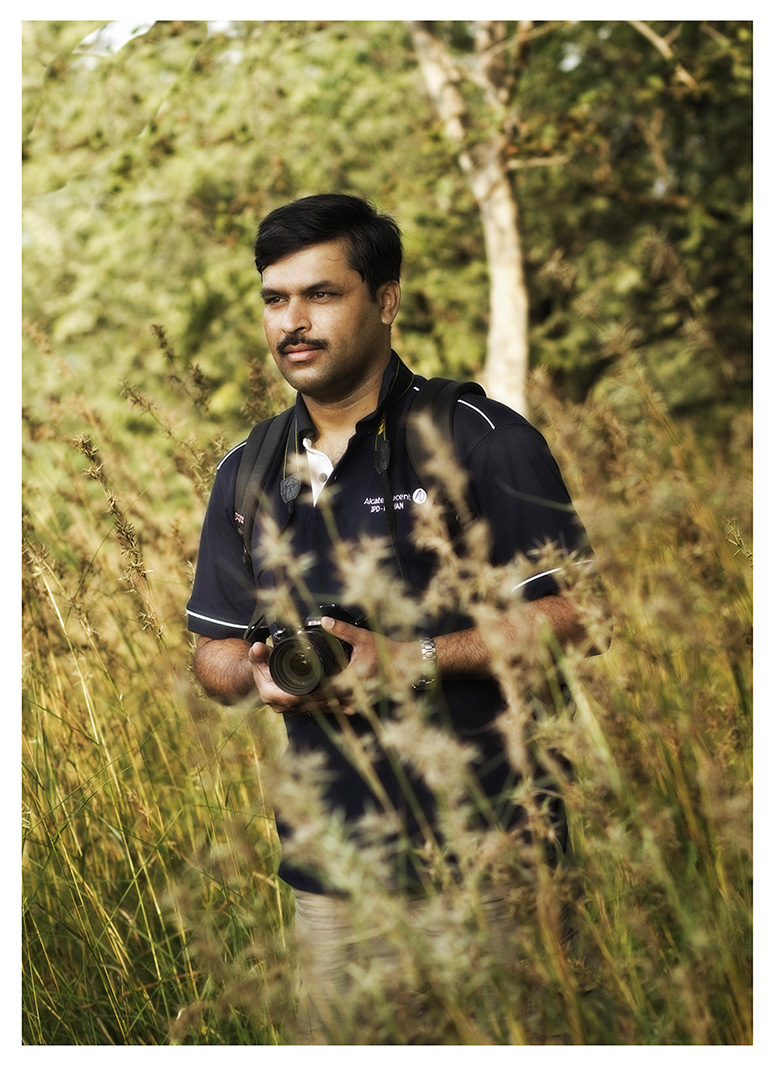
Fill flash

On December 12, 2010, in On Location, Strobist, by Niraj

When it comes to using flash – I generally bounce it off walls, ceilings and any other surface I can get hold of in the vicinity. Well I dont curse myself for that since I mostly shoot indoors with a flash. The light is beautifully directional but with the side-effect of acquiring the color cast of the surface it bounced off of. But what if I didnt have anything to bounce the light off; what if I shot exclusively outdoors…!

I use the Canon 580EXII. In the E-TTL II mode, it defaults to the fill-flash mode. While shooting, the camera first meters ambient light on half-press of the shutter button and then on full press, a low power pre-flash is fired from the flash gun. The reflected light is also metered by the same metering system as used for ambient. An algorithm then calculates the correct flash exposure after comparing the ambient and the flash exposure from – as per the white paper for the 1D MKII – the central 17 metering zones. Areas with large difference between ambient and pre-flash readings are excluded or given a lesser weightage as they are assumed to be a highly reflective object like mirror, glass panes etc.

Unlike E-TTL, E-TTL II can also use distance information provided by compatible lenses (most canon lenses do this). Also, E-TTL II is not completely focus point linked. So regardless of what metering method is selected for ambient metering, the camera uses either evaluative or average (based on selection) to meter the pre-flash exposure.

There are two algorithms that can be used – evaluative and average.  The Evaluative takes into account the inputs from the entire frame for calculating the exposure, whereas the average gives more weight to the zones around the focus point. How the E-TTL II algorithm exactly works has not been revealed by canon. Its left to the user to try out these methods to know what best suits their taste.

I visited Cauvery fishing camp for a couple of days – a team outing. The weather was awesome. Gently overcast with the sun occasionally peeping out from behind the clouds. The light was great for portraiture, all day (barring the short but heavy spell of rain early one evening). This gave me a good overall exposure on the subject but the light still appeared a bit flat and boring for my taste. So I had to make my ‘models’ pose in a way and in locations where there was a gradient of light and then use the flash to fill in the shadows.

Heres the first one where I positioned Pradeep under this huge tree a couple of hops inside the river. The metering was for the background, which was giving me a pretty high exposure. But there was very little light under the tree. I didnt have a ND filter and so had to compromise a little with the background. I overexposed it by 2/3rd of a stop to get more leverage on the foreground subject.

pradeep_under_the_tree

In the shade

Used 580EXII with the white-card and tuned the exposure to -1 on E-TTL. The flash did a great job and I got a nice even exposure with the main light still being directional.

Continue reading »